Colorado Traction Law: Are Your Tires Ready for Winter?
Colorado weather has a way of changing quickly.
You can leave Federal Heights or Westminster on dry pavement and encounter snow, ice and difficult driving conditions by the time you reach the foothills. If you’re heading west on I-70, conditions can change even faster.
That makes fall a good time to ask a simple question:
Are your tires actually ready for a Colorado winter?
It’s especially important this year because Colorado updated its Passenger Vehicle Traction Law beginning in fall 2025. Having an all-wheel-drive (AWD) or four-wheel-drive (4WD) vehicle by itself does not automatically mean you’re prepared for Colorado’s traction requirements.
Here’s what Colorado drivers should know before the snow starts flying.
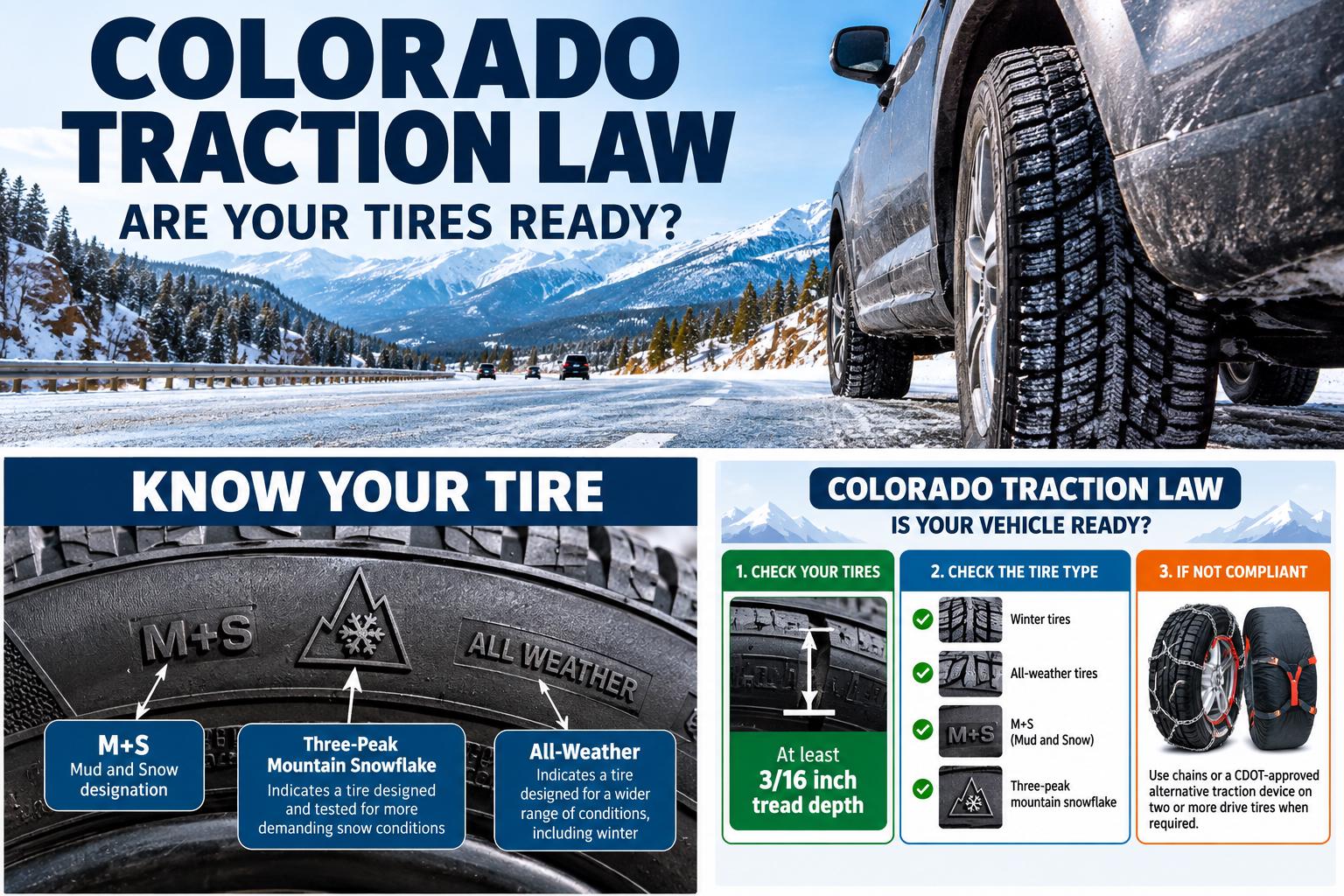
What Is Colorado’s Passenger Vehicle Traction Law?
The Colorado Department of Transportation (CDOT) can activate the Passenger Vehicle Traction Law when winter weather or road conditions make additional traction necessary.
When the Traction Law is in effect, vehicles must meet Colorado’s requirements for adequate tires and traction. Under current CDOT guidance, compliant tires need at least 3/16 inch of tread depth and the appropriate winter, all-weather or mud-and-snow designation. Vehicles that do not meet the applicable requirements need chains or a CDOT-approved alternative traction device on two or more drive tires.
CDOT can activate traction restrictions on any state highway in Colorado, so this isn’t something that matters only to skiers heading into the mountains.
For current road conditions and active restrictions, check COtrip.org before traveling.
What Changed With Colorado’s Traction Law?
One of the most important changes affects drivers of AWD and 4WD vehicles.
There is a common assumption that:
“I have AWD, so I’m good.”
Not necessarily.
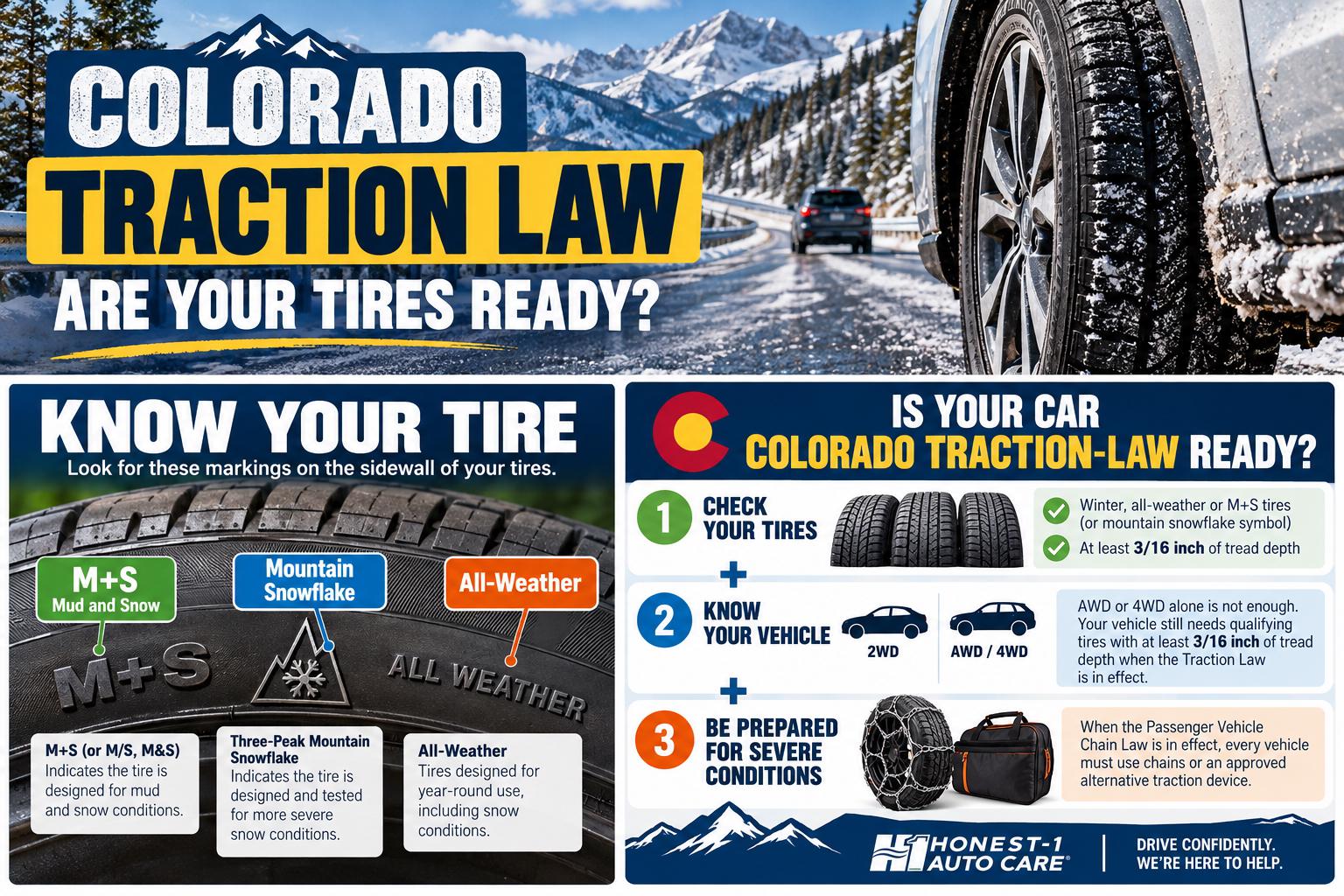
Under Colorado’s updated requirements, AWD and 4WD vehicles also need appropriate tires with at least 3/16 inch of tread depth when the Passenger Vehicle Traction Law is in effect.
That makes sense from a safety standpoint, too.
AWD and 4WD can help a vehicle get moving in slippery conditions, but your tires provide the contact with the road when you need to turn and stop.
No drivetrain can compensate for tires that are worn out or poorly suited to winter conditions.
How Much Tire Tread Does Colorado’s Traction Law Require?
The number to remember is:
3/16 inch
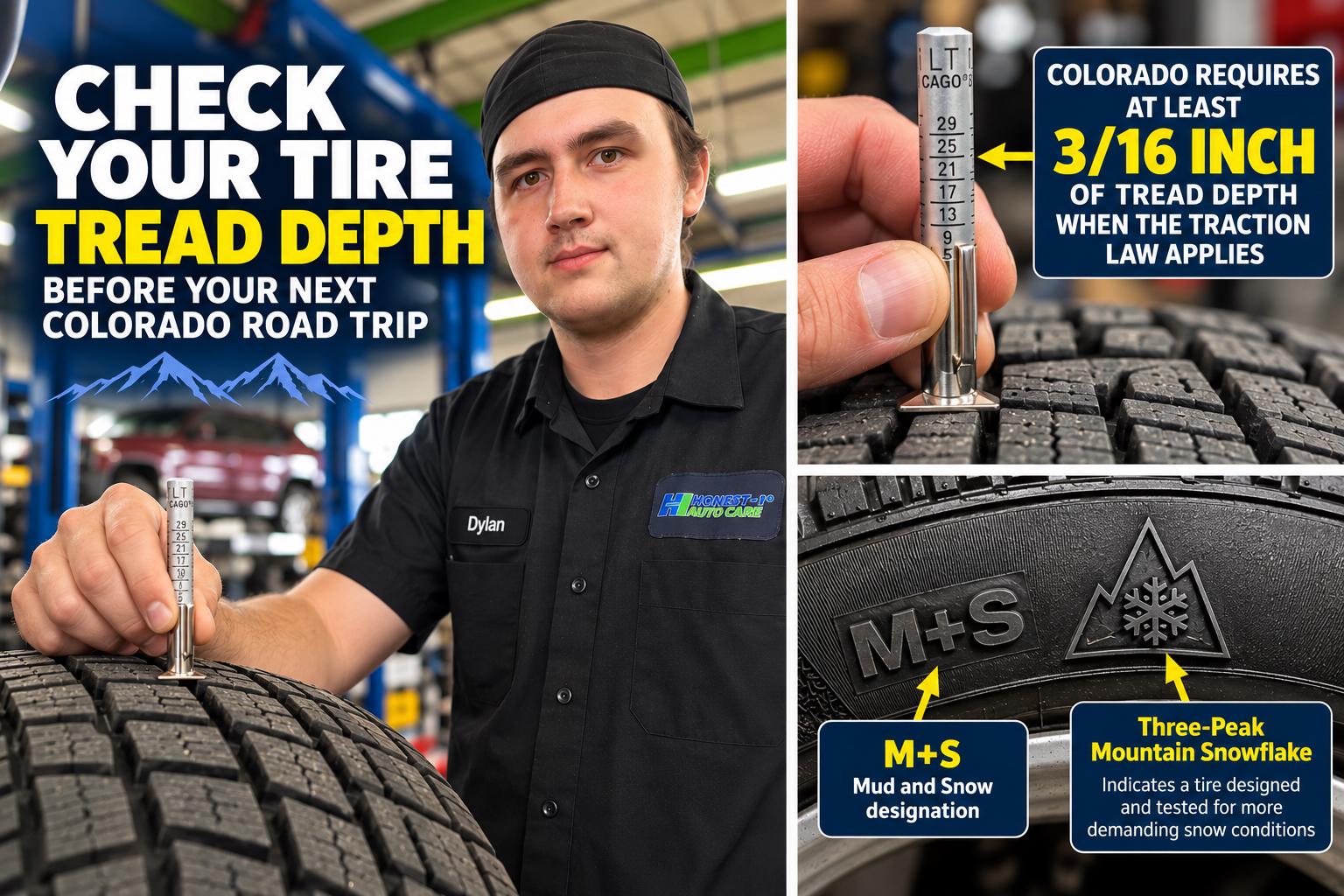
When Colorado’s Passenger Vehicle Traction Law applies, the required minimum tread depth is 3/16 inch.
And don’t assume that because your tires still have visible tread, they automatically meet the requirement.
Tires can also wear unevenly. The outside of a tire may look fine while another section has considerably less tread.
That’s why tread depth should be measured rather than estimated by looking at the tire.
Not sure how much tread you have? Honest1 Auto Care Federal Heights can check it for you.
Do I Need Snow Tires in Colorado?
Not necessarily.
Colorado’s traction requirements recognize several types of qualifying tires, depending on the vehicle and conditions. These can include:
- Winter tires
- All-weather tires
- Tires carrying a mud-and-snow designation such as M+S, M/S or M&S
- Tires displaying the three-peak mountain snowflake symbol
The important point is that the tire must have the appropriate designation and sufficient tread depth for the applicable traction requirements.
If you aren’t sure what kind of tires are currently on your vehicle, look at the tire sidewall—or stop by and we can help you identify them.
What Do M+S and the Mountain Snowflake Symbol Mean?
You may have noticed letters and symbols molded into the side of your tires.
M+S means “Mud and Snow.” You may also see it written as M/S or M&S.
The three-peak mountain snowflake symbol looks like a mountain with a snowflake inside it and is commonly found on tires designed and tested for more demanding snow conditions.
These markings can be important when determining whether your tires meet Colorado’s traction requirements.
But remember: the marking alone isn't enough.
Your tires still need adequate tread.
A qualifying tire that has worn below the required tread depth does not become compliant simply because there is an M+S or mountain-snowflake symbol on its sidewall.
Does AWD or 4WD Make You Safer in the Snow?
AWD and 4WD can be extremely helpful in Colorado, particularly when accelerating on slippery or snow-covered roads.
But they can also create a false sense of security.
AWD helps distribute power to multiple wheels. It does not magically create additional grip between worn tires and an icy road.
When you hit the brakes, the condition of your tires matters enormously.
That’s one reason we recommend looking at the entire vehicle—not simply whether the badge on the back says AWD.
What About Chains?
Colorado has both a Passenger Vehicle Traction Law and a more restrictive Passenger Vehicle Chain Law.
They are not the same thing.
During severe winter storms, CDOT may activate the Passenger Vehicle Chain Law as a final safety measure before closing a highway.
When the Passenger Vehicle Chain Law is in effect, every vehicle must use chains or an approved alternative traction device.
If you regularly travel into Colorado’s mountains during the winter, it makes sense to know:
- Whether your vehicle can use chains
- The correct chain size for your tires
- Whether an approved alternative traction device is appropriate
- How to install your traction equipment before you actually need it
The side of I-70 in a snowstorm is not the ideal place to learn how your chains work for the first time.
How Can I Tell if My Tires Are Ready for Winter?
Tread depth is important, but it isn't the only thing we look at.
A good winter tire inspection should include:
- Tread depth — Is there enough tread remaining?
- Uneven wear — Is one section wearing faster than another?
- Tire pressure — Are the tires properly inflated?
- Cracking or damage — Are there signs of aging, cuts or sidewall damage?
- Tire type — Are the tires appropriate for how and where you drive?
- Overall age and condition — Does the tire's condition raise safety concerns?
Your driving habits matter, too.
Someone commuting around Federal Heights and Westminster has different needs from someone driving to Summit County every weekend.
The right answer isn't automatically, “You need new tires.”
Sometimes the right answer is:
“Your tires look good. You're ready to go.”
We think customers deserve to hear that, too.
Colorado Winter-Ready Vehicle Checklist
Tires are important, but they are only one part of getting your vehicle ready for winter.
Before temperatures drop—or before your first mountain trip—consider checking:
Tires
Check tread depth, tire pressure, wear patterns and overall condition.
Battery
Cold weather can expose a battery that was already becoming weak. If your battery is questionable going into winter, it's better to find out in the shop than on a cold morning when the car won't start.
Coolant
Make sure your cooling system has the proper coolant level and freeze protection.
Wiper Blades
If your wipers streak, chatter or leave areas of the windshield uncleared, replace them before the first heavy snow.
Windshield Washer Fluid
Use washer fluid appropriate for freezing Colorado temperatures and keep the reservoir full.
Brakes
Snow and ice make traction more limited. Your braking system needs to be in good working condition before winter driving begins.
Lights
Shorter days and snowstorms mean more driving in reduced visibility. Check headlights, brake lights and turn signals.
Heater and Defroster
Make sure the heater and windshield defroster are working properly.
Emergency Supplies
For mountain travel, consider carrying warm clothing or blankets, water, a flashlight, phone charger and other basic emergency supplies.
Chains or an Approved Traction Device
If your travel plans or vehicle require them, make sure you have the correct equipment—and know how to use it.
Check Road Conditions
Before heading into the mountains, check current conditions and restrictions at COtrip.org.
Do Colorado’s Traction Laws Matter if I Mostly Drive Around Denver?
Yes.
The legal requirements depend on where traction restrictions are active, but winter tire safety isn't limited to the mountains.
Federal Heights, Westminster, Thornton and the rest of the Denver metro area can experience snow, packed ice, freezing temperatures and rapidly changing road conditions.
And many Front Range drivers who spend most of their week commuting locally eventually head west on I-70 for skiing, snowboarding, a weekend getaway or holiday travel.
Preparing the vehicle before that trip is much easier than discovering a problem halfway up the mountain.
Frequently Asked Questions About Colorado’s Traction Law
What is the minimum tire tread depth for Colorado’s Traction Law?
Under current CDOT requirements, qualifying tires need at least 3/16 inch of tread depth when the Passenger Vehicle Traction Law applies.
Does AWD automatically satisfy Colorado’s Traction Law?
No. Under Colorado’s updated requirements, AWD or 4WD alone does not automatically make a vehicle compliant. Appropriate tires and sufficient tread depth are also important, or chains/an approved alternative traction device may be required.
Do I have to buy snow tires to drive in Colorado?
Not necessarily. Depending on the vehicle and applicable traction requirements, qualifying winter, all-weather and mud-and-snow tires can satisfy tire requirements when they have sufficient tread depth.
Can Colorado activate the Traction Law outside I-70?
Yes. CDOT can activate the Passenger Vehicle Traction Law and Passenger Vehicle Chain Law on state highways when conditions warrant.
What's the difference between the Traction Law and the Passenger Vehicle Chain Law?
The Passenger Vehicle Traction Law establishes tire and traction requirements during winter conditions. The Passenger Vehicle Chain Law is more restrictive and may be activated during severe storms. When the Passenger Vehicle Chain Law is active, every vehicle must use chains or an approved alternative traction device.
Can Honest1 Auto Care Federal Heights check whether my tires are ready?
Yes. If you're unsure about your tire tread or condition, stop by Honest1 Auto Care Federal Heights. We can check your tires and help you understand what you have.
Not Sure if Your Car Is Colorado-Winter Ready?
You don't have to guess.
At Honest1 Auto Care Federal Heights, we'll check your tire tread and overall tire condition and tell you what we see.
If your existing tires are in good shape, we'll tell you that.
If they're worn or there is something that concerns us, we'll explain what we found and discuss your options. We can provide replacement tires when needed, but our goal isn't to sell you tires you don't need.
Our goal is to help you know whether your vehicle is ready for the road ahead.
Stop by Honest1 Auto Care Federal Heights for a free tire and tread check before your next winter or mountain drive.
Sources and Additional Information
Colorado Department of Transportation, Passenger Vehicle Traction and Chain Laws:
https://www.codot.gov/travel/winter-driving/tractionlaw
Colorado Department of Transportation, Winter Driving Frequently Asked Questions:
https://www.codot.gov/travel/winter-driving/faqs
For current Colorado road conditions and active traction restrictions:
https://www.cotrip.org