Car Won’t Start? Is It the Battery, Alternator, or Starter?
You get in your car, turn the key or press the start button—and nothing happens.
Or maybe you hear clicking. The engine turns over slowly. The dashboard lights come on, but the engine doesn’t crank. Maybe a jump gets you going, only for the same problem to return the next morning.
The first question is usually the same:
Is it the battery, alternator, or starter?
The symptoms can provide some useful clues, but they don't always tell the whole story. A weak battery, failing alternator, bad starter, corroded connection, or another electrical problem can produce similar symptoms.
That's why testing the starting and charging system is usually smarter—and less expensive—than replacing parts based on a guess.
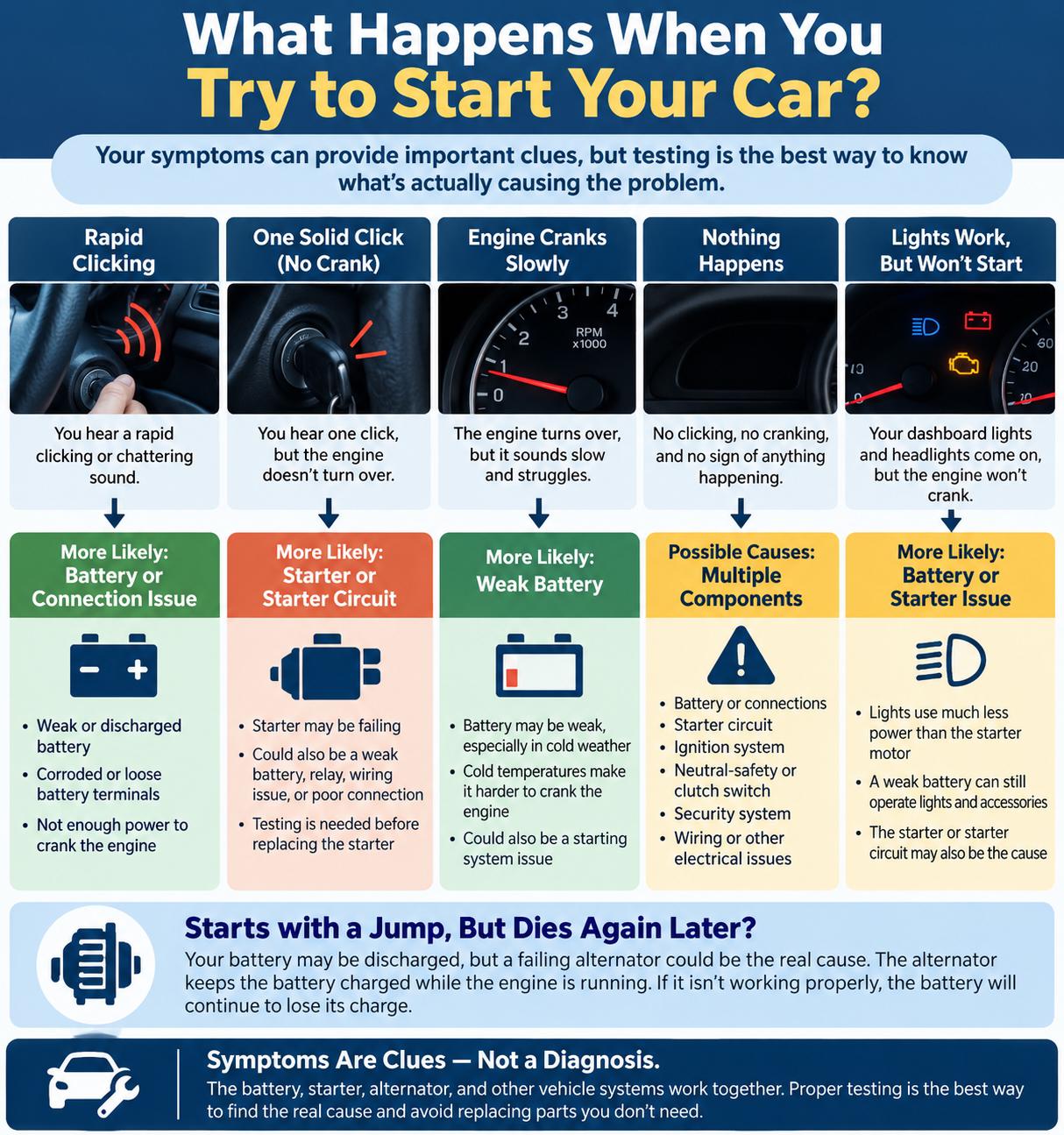
What Happens When You Try to Start the Car?
Start with what you hear and see when you turn the key or press the start button.
Rapid clicking
A rapid clicking or chattering sound often points toward a weak battery or poor battery connection. There may be enough electrical power to activate the starter solenoid, but not enough to crank the engine.
Check the battery terminals for obvious looseness or corrosion but remember: a battery can look perfectly fine from the outside and still be weak.
One solid click, but the engine doesn't turn
A single click with no engine cranking can make the starter or starter circuit more suspicious.
However, don't order a starter based on the sound alone. A weak battery, poor electrical connection, relay, wiring issue, or other problem can sometimes create similar symptoms.
The engine cranks slowly
If the engine sounds like it's struggling to turn over—especially on a cold Colorado morning—a weak battery is high on the list of possibilities.
Cold temperatures reduce a battery's ability to deliver power. At the same time, a cold engine can require more effort to crank. That combination is one reason a marginal battery may seem fine during warmer weather and suddenly cause trouble when temperatures drop.
Nothing happens at all
No clicking and no cranking doesn't automatically mean the battery is dead.
Possible causes include the battery, battery connections, starter circuit, ignition system, neutral-safety or clutch switch, security system, wiring, or other electrical components.
This is where diagnosis becomes especially important.
The lights work, but the car won't start
This is a common source of confusion.
Your headlights and dashboard lights coming on does not prove that the battery is good.
Lights require much less electrical power than the starter motor. A weak battery may still operate lights, the radio, and other accessories while being unable to provide enough power to crank the engine.
Signs the Battery May Be the Problem
The battery supplies the electrical power needed to crank the engine when you start the vehicle.
Common clues of a weak or failing battery can include:
- Slow engine cranking
- Rapid clicking when you try to start
- Interior or dashboard lights that dim substantially during starting
- Needing a jump-start
- Starting problems that are worse in cold weather
- Repeated dead-battery problems
But even these symptoms aren't proof that the battery itself is bad.
For example, a good battery can become discharged because the alternator isn't charging it properly. Something in the vehicle can also draw power while the car is parked.
Replacing the battery without finding the underlying problem can leave you right back where you started.
Signs the Starter May Be the Problem
The starter motor uses electrical power from the battery to turn the engine over.
Possible signs of a starter or starter-circuit problem include:
- A single click when you attempt to start the vehicle
- Dashboard lights appear normal, but the engine doesn't crank
- Intermittent no-crank problems
- The engine sometimes starts normally, and other times doesn't crank at all
Again, these are clues rather than a diagnosis.
Before replacing a starter, the battery, cables, connections, relays, wiring, and related starting components may need to be checked.
Signs the Alternator May Be the Problem
Once the engine is running, the alternator supplies electrical power and helps keep the battery charged.
A failing alternator may cause symptoms such as:
- A battery or charging-system warning light
- Headlights or interior lights that dim or flicker
- Electrical accessories behaving strangely
- A battery that repeatedly loses its charge
- A vehicle that starts after a jump but later has another dead battery
- In some cases, an engine that stops running after the charging system can no longer support the vehicle
A dead battery and a bad alternator can therefore look very similar from the driver's seat.
The dead battery may be the symptom—not the cause.
“It Started with a Jump. Doesn't That Mean the Battery Is Bad?”
Not necessarily.
A successful jump-start tells us that the vehicle didn't have adequate electrical power available to start on its own. It does not, by itself, tell us why.
The battery might be weak.
The battery might simply be discharged.
The alternator may not be charging correctly.
There could be excessive electrical draw while the vehicle is parked.
Or there may be a problem with the battery cables or connections.
That's why replacing the battery simply because the car needed a jump can sometimes become an expensive guess.
Why Colorado Cold Weather Exposes Weak Batteries
Drivers around Federal Heights, Westminster, Northglenn, Thornton, and the Denver metro area know how quickly Colorado weather can change.
Cold temperatures are particularly tough on automotive batteries because battery performance decreases as temperatures fall.
That means a battery that seemed perfectly normal through summer may begin cranking slowly when the first genuinely cold mornings arrive.
This is also why fall is a good time to pay attention to changes in how your vehicle starts.
If the engine suddenly seems to crank more slowly than it did a few months ago, don't ignore it simply because the car still starts. That change may be an early warning that the starting or charging system deserves attention.
What Can You Check Yourself?
If your car won't start, there are a few simple observations that can help.
Listen carefully.
Do you hear rapid clicking, one click, slow cranking, normal cranking, or nothing?
Watch the lights.
Do the dashboard or headlights become noticeably dimmer when you try to start the engine?
Look at the battery terminals.
Obvious corrosion or a loose connection can cause starting problems.
Think about what happened before the problem.
Was a light left on? Has the vehicle been sitting for an extended period? Has it been starting more slowly lately? Did a battery warning light appear while driving?
If appropriate, try a jump-start.
Follow the procedures in your vehicle owner's manual. Modern vehicles can have manufacturer-specific jump-start instructions and designated connection points.
These observations can provide useful clues, but they still don't replace testing.
A Parts-Store Test Isn't Always the Same as a Diagnosis
A battery test can tell you useful information about the battery. A charging-system test can provide useful information about charging voltage and system performance.
But identifying a test result isn't necessarily the same thing as determining why the vehicle won't start.
The starting and charging systems work together.
If a battery is discharged, the next question should be why.
If the starter isn't receiving adequate power, the next question should be why.
If charging-system performance is abnormal, the alternator itself may not be the only possible cause.
Good diagnosis means looking at the system instead of simply replacing whichever component seems most likely.
Don't Throw Parts at a Starting Problem
When a car won't start, it's tempting to begin with the most obvious component:
"Let's put a battery in it and see what happens."
Sometimes that works.
Sometimes it results in a new battery and exactly the same problem.
The same applies to alternators and starters.
Modern vehicles have increasingly complex electrical systems, and several different problems can produce remarkably similar symptoms. Testing the battery, starting system, charging system, electrical connections, and related components can help identify the actual cause before money is spent replacing parts.
Car Won't Start in Federal Heights or the North Denver Area?
At Honest1 Auto Care Federal Heights, we help drivers from Federal Heights, Westminster, Northglenn, Thornton, and surrounding Denver-area communities diagnose starting and charging problems.
Our approach is straightforward:
Test it. Find the problem. Explain what we found. Then you decide what happens next.
If your vehicle is cranking slowly, clicking when you try to start it, repeatedly needing a jump, or simply won't start, give us a call before replacing parts.
We'd rather help you determine what's actually wrong than sell you a part you may not need.
Frequently Asked Questions
Why does my car click but not start?
Rapid clicking often occurs when the starter isn't receiving enough electrical power, commonly because of a weak battery or poor connection. A single click can point toward the starter or starter circuit. Because several problems can cause similar symptoms, testing is the best way to identify the cause.
Can my battery be bad even if the lights still work?
Yes. Headlights, dashboard lights, and the radio require considerably less power than the starter motor. A battery may have enough power for accessories but not enough to crank the engine.
If my car starts with a jump, does that mean I need a new battery?
Not necessarily. The battery could be weak, but it could also simply be discharged. A charging-system problem, poor electrical connection, or electrical draw while the vehicle is parked could also contribute.
Can a bad alternator cause a dead battery?
Yes. The alternator helps maintain the battery's charge while the engine is running. If the charging system isn't operating properly, the battery can gradually become discharged.
Why does my car have trouble starting when it's cold?
Low temperatures reduce a battery's ability to deliver power, which can expose a battery or starting-system weakness that wasn't obvious during warmer weather.
Why does my battery keep going dead?
A failing battery is one possibility, but repeated discharge can also result from charging-system problems, poor electrical connections, or something drawing power while the vehicle is parked. The goal should be to determine why the battery is losing its charge rather than repeatedly recharging or replacing it.
Should I replace the battery, alternator, or starter first?
Ideally, none of them until you know which component is actually causing the problem. Because the battery, starter, alternator, cables, connections, and vehicle electronics interact, testing first can prevent unnecessary repairs.
Need Help Figuring Out Why Your Car Won't Start?
Call Honest1 Auto Care Federal Heights before replacing parts.
We'll diagnose the problem, explain what we find, and let you decide what happens next.
We Explain. You Decide.